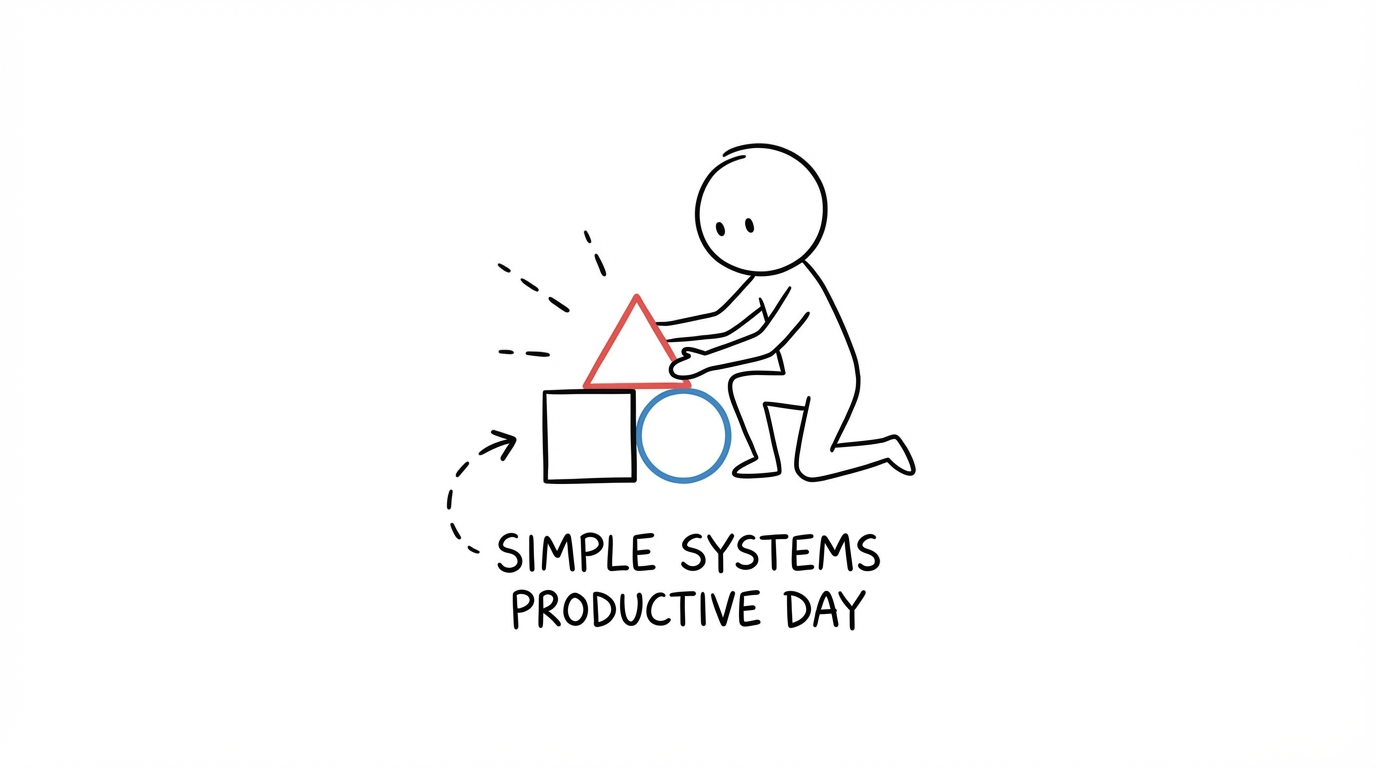
Most productivity problems aren’t caused by laziness.
They’re caused by mixing two different jobs: deciding what matters and trying to do it at the same time.
When planning and doing blur together, nothing feels clear. You start many things. You finish few.
Progress slows.
The mind needs one decision at a time
Your brain works best when it has a single role.
- Planning requires judgment.
- Doing requires focus.
When you try to do both at once, you drain energy fast.
That’s why simple systems work. They reduce decisions.
Decide tomorrow before it starts
The day goes better when priorities are decided in advance.
Not in the morning. Not during the rush.
The night before.
When you already know what matters most, the day feels lighter. There’s less negotiation. Less mental friction.
You don’t need a long list. You need a short one.
Focus works best in short bursts
Once a priority is chosen, the next problem is attention.
Big tasks feel heavy. Open-ended time invites distraction.
Short, defined work periods change that.
When the time is limited, focus increases. Resistance drops. Starting becomes easier.
You’re not committing to finishing everything. You’re committing to staying present for a short stretch.
That’s enough.
Why this combination works
Decide first. Then focus.
One removes confusion. The other removes procrastination.
Together, they create momentum.
You stop asking: “What should I work on?” and “How long will this take?”
Instead, you simply work.
Consistency beats intensity
You don’t need a perfect system. You need a repeatable one.
Simple methods succeed because they can be used every day. Even on tired days. Especially on tired days.
Progress comes from showing up with clarity, not force.
One action
Tonight, choose tomorrow’s first task.
Just one.
Write it down. Set a 25-minute timer. Work only on that task until the timer ends.
Stop when it ends.
You don’t need to finish the day.
Finish one focused block — and let momentum do the rest.