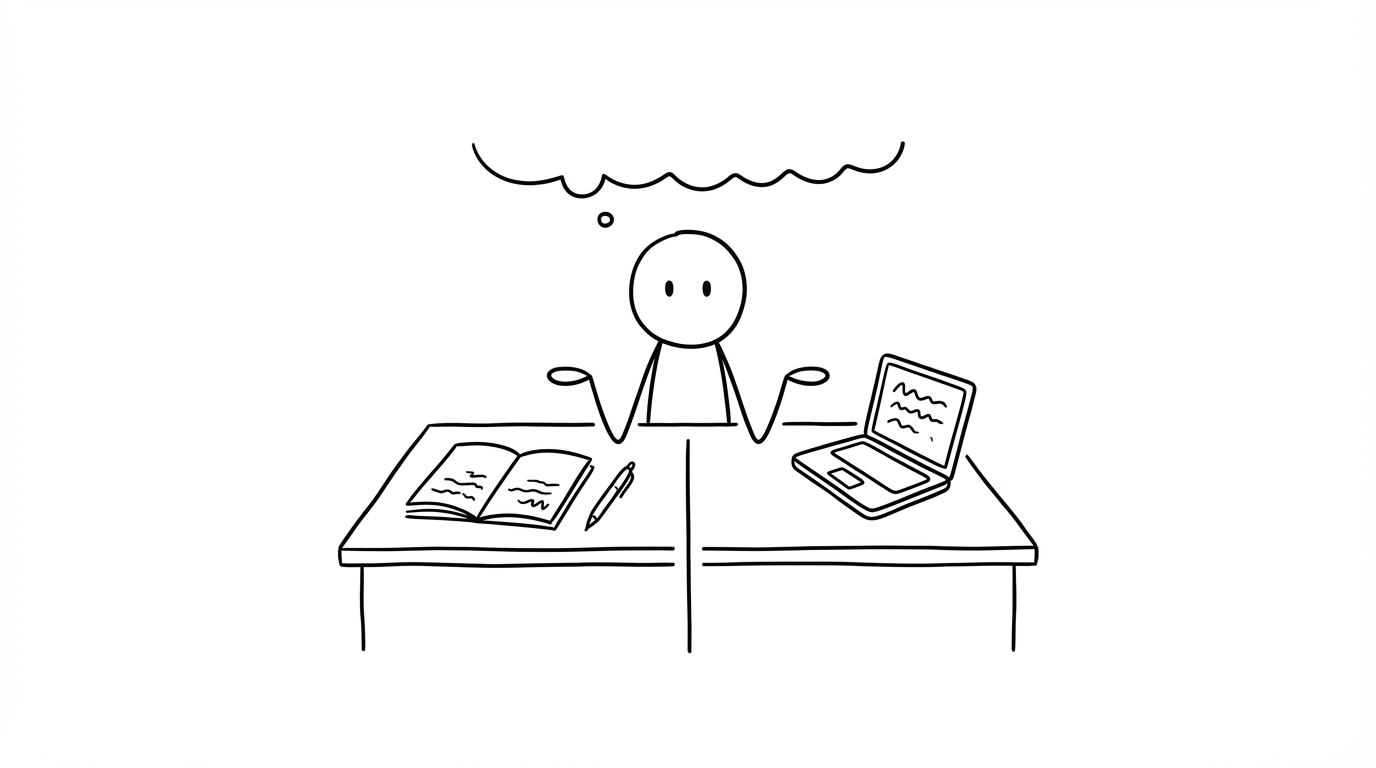
Screens are powerful tools.
They help us communicate, remember appointments, and access information instantly.
They’re also excellent at pulling our attention away from what matters.
When the goal is thinking clearly, paper still has the edge.
Why writing by hand works differently
Typing is fast because it’s mechanical. Your fingers move without much thought.
Writing by hand is slower. That’s the point.
When you write, your brain processes information more deeply. You don’t just record ideas — you translate them.
That extra effort improves memory and understanding.
This is why handwritten notes are easier to remember than typed ones. You’re activating more than one kind of memory at the same time.
Paper gives freedom, not options
Digital tools offer features. Paper offers freedom.
On paper, you can:
- write anywhere
- sketch without modes
- connect ideas visually
- change direction instantly
There’s no formatting. No menus. No decisions about tools.
The page stays quiet so your thinking can move.
Paper always works
Paper doesn’t crash. It doesn’t update. It doesn’t need charging.
It’s predictable.
Digital tools are powerful, but fragile. Formats change. Files disappear. Devices fail.
Paper ages slowly and visibly. That reliability creates trust — and trust reduces friction.
Focus improves when the tool can’t multitask
Screens are designed to interrupt. Humans aren’t designed to handle that well.
Even simple digital notes invite distraction: notifications, formatting choices, app switching.
Pen and paper do one thing. That constraint helps the mind stay with the task.
Less stimulation. More attention.
Paper creates a natural pause from screens
Screens demand constant engagement. Paper allows rest.
Writing on paper:
- reduces eye strain
- slows the pace
- keeps you present
There’s satisfaction in physically checking something off. A sense of closure screens rarely provide.
And paper never lights up in the middle of the night.
Use each tool where it works best
This isn’t about choosing sides.
Digital tools are ideal for:
- calendars
- reminders
- files
- communication
Paper is best for:
- planning your day
- journaling
- weekly reviews
- thinking through problems
When reflection matters, paper wins.
One action
Plan tomorrow on paper.
Write your top priorities by hand. No apps. No screens.
Notice how it feels to slow down and decide deliberately.
Sometimes, better tools mean simpler ones.